
Best Budget Smartphones Buying Guide 2026

Gone are the days when top-notch phones cost a fortune. You can snag solid performance, sharp cameras, and long battery life without emptying your wallet. In 2026, budget smartphones hit that sweet spot, offering features once reserved for high-end models. This guide helps you pick the best budget smartphone for your needs, so you get power on a dime.
Budget buyers in 2026 have more options than ever. Chip makers push faster processors down to affordable tiers. Battery tech improves, giving you all-day use without worry. Cameras now capture great shots in low light, and 5G runs smooth on most models under $400. High-quality displays with smooth scrolling pop up in this range too.
We define “budget” here as phones under $400. This covers ultra-budget picks around $200 for basics. Premium budget options near $400 add extras like better screens or more storage. You avoid junk while staying in reach.
Essential Hardware Considerations for Budget Buyers
Hardware sets the base for how your phone feels day to day. Skip weak specs, and you’ll regret it later. Focus on these to ensure smooth use and lasting value.
Processor Power: Decoding Chipsets for Smooth Performance
The chipset drives everything from app speed to game play. In 2026, budget phones use Snapdragon 6 or 7 series chips. These handle multitasking without lags. MediaTek Dimensity 7000 chips match them for daily tasks.
Look for scores above 500,000 on AnTuTu benchmarks. That means fluid scrolling and quick loads. For light gaming, aim for chips with good GPU support. Test reviews from sites like GSMArena for real scores.
Weak processors drain battery fast. Strong ones keep things zippy for years.
Display Quality: Beyond Just Resolution (Refresh Rates Matter)
A good screen makes videos pop and texts easy to read. Budget models now offer 90Hz or 120Hz refresh rates. This gives buttery smooth swipes, unlike old 60Hz ones.
OLED screens bring deep blacks, but quality LCDs save cash and still look sharp. Go for Full HD+ resolution at least. Size around 6.5 inches fits most hands.
Trade-offs? LCDs wash out in sun, but they’re brighter overall. Check peak brightness over 500 nits for outdoor use.
RAM and Storage: The Minimum Viable Specs for Longevity
Six GB of RAM is your baseline now. It juggles apps without hiccups. Eight GB feels even better for heavy use.
Storage starts at 128GB. That’s room for photos, apps, and files. Expandable slots via microSD add more if needed.
Less than 4GB RAM leads to crashes. Always verify if storage expands—key for media lovers.
Photography on a Dime: Evaluating Budget Cameras
Cameras trip up many budget picks. But smart software fixes that. You don’t need huge megapixels; focus on how shots turn out.
Sensor Size and Image Processing: Where the Magic Happens
Bigger sensors catch more light, but processing software shines in budgets. Night mode uses AI to brighten dark scenes without noise.
Google’s tools or Samsung’s tweaks make colors pop. Test samples on YouTube for real views.
Raw pixels fool no one—check processed images for detail and true tones.
Versatility Check: Ultrawide and Macro Lenses
Ultrawide lenses widen your view for landscapes or groups. They’re useful more than macro ones, which zoom close but blur easy.
Skip depth sensors; they’re gimmicks. Prioritize a solid main camera plus ultrawide.
In budgets, these add fun without bulk. But software must handle them well.
Video Capabilities: Stabilization and Frame Rates
Expect steady 1080p at 30fps on most. Some hit 4K with basic stabilization. Shake reduction matters for walks or talks.
Frame rates over 60fps smooth action, but rare under $400. Check if EIS (electronic image stabilization) works.
Videos beat photos for memories—pick phones that deliver clear clips.
Battery Life and Charging Speed Dominance
Battery rules your day. Budget phones often outlast flagships here. Big capacities and smart tech keep you plugged in less.
mAh vs. Real-World Endurance Testing
A 5000mAh battery means 7-8 hours of screen time. That’s streaming, browsing, and calls.
Reviewers like Tom’s Guide test this. One model might hit 10 hours mixed use. Factor your habits—gamers need more.
Don’t chase max mAh; efficiency counts too.
Fast Charging Standards: Getting Back to 100% Quickly
33W charging fills most in under an hour. Some reach 45W. Check if the charger comes free—saves $20.
Wireless skips budgets, but wired speed wins. Avoid 18W; it’s too slow now.
Software Optimization for Battery Longevity
Clean software sips power. Stock Android wastes less than bloated skins. Modes like adaptive battery learn your use.
Update apps to keep things lean. This stretches charge over two days light use.
Software, Security, and Longevity Commitment
Software keeps your phone safe and fresh. Ignore this, and it ages fast. Look for strong promises.
Update Policies: How Many Years of OS and Security Patches?
Samsung and Google offer 3 years of OS upgrades in budgets. That’s Android 17 to 20 by 2029.
Security patches monthly for 4-5 years beat others. Motorola lags at 2 years—avoid if you can.
Long support means no forced upgrade soon.
The Operating System Experience: Stock vs. Customized Interfaces
Stock Android feels clean, no junk apps. Pixel phones nail this.
Custom skins add features but bloat. Samsung’s One UI balances both. Test in stores for feel.
Stability trumps flash—pick what runs smooth.
Essential Connectivity: Ensuring Future-Proofing (5G and Wi-Fi Standards)
5G is must-have. Ensure sub-6GHz bands for your area. mmWave is bonus, rare in budgets.
Wi-Fi 6 speeds home nets. Check specs for both.
This keeps you connected as networks grow.
Top Contenders: Spotlighting the Best Budget Smartphones of 2026
These picks shine under $400. We chose based on tests from CNET and Android Authority. Each beats rivals in key ways.
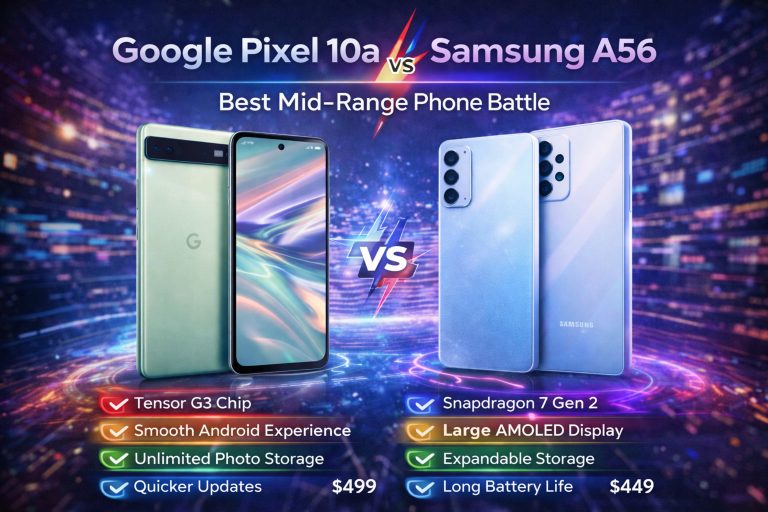
The All-Rounder Champion (Samsung Galaxy A56)
The Galaxy A56 nails balance at $350. Its 6.6-inch 120Hz Super AMOLED screen beats the Moto G Stylus in color accuracy. Battery lasts 9 hours screen-on, thanks to the Exynos 1480 chip.
Camera setup includes a 50MP main with good night shots. 128GB storage expands to 1TB. It gets 4 years of updates, more than most.
No weak spots—perfect for everyday use.
The Photography Specialist (Google Pixel 8a)
Pixel 8a at $399 steals the show for photos. Tensor G3 chip powers AI edits that outshine the Nothing Phone (2a). Ultrawide lens captures wide scenes without distortion.
Video hits 4K/60fps stable. Battery 4500mAh gives 7.5 hours, solid for its size. Stock Android with 7 years updates—best in class.
If snaps matter, this wins.
The Performance Powerhouse (OnePlus Nord 4)
Nord 4 at $379 crushes games with Snapdragon 7+ Gen 3. It scores 750,000 on AnTuTu, topping the Realme GT 6T. 120Hz AMOLED feels fluid.
5000mAh battery plus 80W charging—full in 30 minutes. Camera is decent 50MP, but speed shines. OxygenOS updates for 4 years.
Gamers, grab this.
Conclusion: Making the Smartest Purchase Decision
Budget smartphones in 2026 pack real punch. You get fast chips, great batteries, and solid cameras without breaking the bank. Match your pick to needs, and you’ll love it.
Final Checklist: Five Non-Negotiable Takeaways
- Demand at least 90Hz display for smooth feel.
- Verify 6GB RAM minimum to avoid slows.
- Check for 3+ years of software updates.
- Ensure 5000mAh battery for all-day power.
- Confirm 5G support in your region.
Beyond the Price Tag: Focusing on User Experience
Think about what you do most. Heavy texter? Prioritize battery. Photo fan? Go camera strong. Test in person if possible. Your daily joy comes from fit, not just specs.
Ready to upgrade? Compare these tips side-by-side. You’ll score a winner that lasts.