
Redmi Note 14 vs Galaxy A35: Midrange Comparison
The midrange smartphone market stays packed with options under $500. Brands like Xiaomi’s Redmi series and Samsung’s Galaxy A line keep pushing the envelope. You face tough choices when picking one that lasts.
This article pits the new Redmi Note 14 against the solid Galaxy A35. We compare their performance, looks, cameras, battery, and value. Our goal? Help you pick the best fit for daily use and long-term bang for your buck.
Design and Display: Aesthetics Meet Durability
Build Quality and Ergonomics
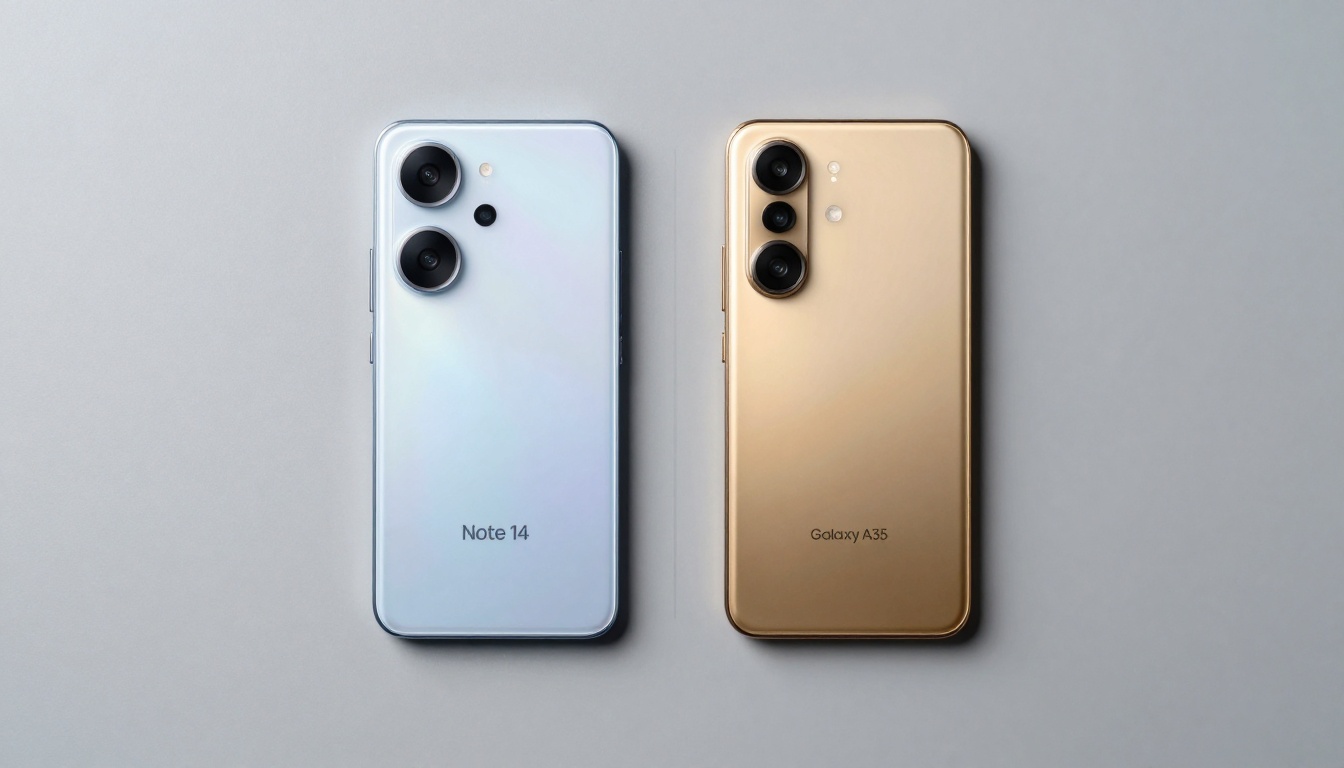
Both phones feel good in your hand, but they differ in materials. The Galaxy A35 uses a plastic back with a glass front, paired with an IP67 rating for dust and water resistance. It weighs about 209 grams and measures 161.7 x 78 x 8.2 mm, making it slim and easy to grip.
The Redmi Note 14 goes for a Glasstic back that mimics glass without the shatter risk. Its IP54 rating handles splashes but not full submersion. At 190 grams and 162.5 x 75.4 x 8 mm, it feels lighter and more compact for one-handed use.
Over time, the A35’s premium finish might hold up better against scratches. If you drop your phone often, Samsung’s tougher build could save you hassle.
Screen Technology Showdown
Screens make or break your phone experience. The Galaxy A35 rocks a 6.6-inch Super AMOLED display with FHD+ resolution and a 120Hz refresh rate. It hits 1,000 nits peak brightness, so you see details clearly even in sunlight. Gorilla Glass Victus protects it from cracks.
Redmi Note 14 counters with a 6.67-inch AMOLED panel, also FHD+ and 120Hz smooth. Brightness tops at 2,100 nits, ideal for bright days outdoors. It uses Gorilla Glass 5 for solid protection against daily bumps.
Samsung’s colors pop more naturally for movies. Yet, Redmi’s higher brightness edges it out for outdoor scrolling. Both handle gaming and videos well, but pick based on your light conditions.
Performance Deep Dive: Chipset, Speed, and Gaming
Processor Benchmarks and Real-World Speed
Power under the hood sets these apart. The Galaxy A35 runs on the Exynos 1380 chipset with 6GB or 8GB RAM options. In Geekbench tests, it scores around 1,000 single-core and 2,900 multi-core. AnTuTu hits about 500,000, smooth for apps and light edits.
Redmi Note 14 packs a MediaTek Dimensity 7200 Ultra, with up to 12GB RAM. Geekbench shows 950 single-core and 3,000 multi-core. AnTuTu pushes 650,000, giving it a speed boost for multitasking.
In real use, Samsung stays cool during long sessions, thanks to better heat control. Redmi heats up a bit in games but throttles less. If you game hard, the Note 14 pulls ahead.
Software Experience and Longevity
Software keeps your phone fresh. The A35 uses One UI on Android 14, with four years of OS updates and five years of security patches. It feels clean and easy, with Samsung’s ecosystem perks like easy Galaxy Watch pairing.
Redmi Note 14 ships with HyperOS based on Android 14. Xiaomi promises three major updates and four years of security fixes. The interface packs more features, like customizable themes, but some ads sneak in.
Samsung wins for long-term support, matching industry leaders. Analysts say this matters for resale value. If you keep phones years, go A35; for fun tweaks now, try Redmi.
Camera Capabilities: Hardware vs. Computational Photography
Main Sensor Performance and Versatility
Cameras shine in good light but struggle at night. Galaxy A35’s 50MP main sensor has a 1/1.96-inch size and f/1.8 aperture. It captures natural colors and sharp details in daylight. Low light? Night mode boosts clarity without too much noise.
Redmi Note 14 features a 108MP primary with a smaller sensor but wider f/1.75 aperture. It delivers vibrant shots that pop on social media. In dynamic scenes, like sunsets, Redmi handles range better.
Samsung’s processing feels true-to-life, great for prints. Redmi’s bold hues suit Instagram feeds. Test in your scene—both impress for the price.
Supporting Lenses and Video Recording
Extra lenses add fun. A35 includes an 8MP ultrawide for landscapes and 5MP macro for close-ups. Video tops 4K at 30fps with decent stabilization, though no OIS on the main.
Redmi offers a 8MP ultrawide, 2MP macro, and depth sensor. It records 4K too, with OIS for steadier clips during walks. Selfies? Both have 13MP fronts that work fine in groups.
Samsung edges video smoothness for vlogs. Redmi’s OIS helps casual shooters. Neither wows pros, but they beat basic snaps.
Battery Life and Charging Ecosystem
Endurance Testing
Battery keeps you going all day. Galaxy A35 has a 5,000mAh cell. In tests, it lasts 10 hours of screen time with mixed use—browsing, calls, and streams.
Redmi Note 14 matches with 5,000mAh. It squeezes out 11 hours, thanks to efficient chip. Heavy gamers see similar drain on both.
Real life varies by habits. Both outlast older models, but Redmi’s optimization gives a slight win for long days.
Charging Speeds and Convenience
Speed matters when you’re rushed. A35 supports 25W wired charging—no brick in the box. It reaches 50% in 30 minutes.
Redmi Note 14 zips at 67W, including the charger. You hit 50% in 20 minutes, full in under an hour. No wireless on either, but USB-C works for both.
Xiaomi’s faster fill-up suits busy folks. Samsung’s slower pace feels dated, yet reliable.
Pricing, Value Proposition, and Final Verdict
Market Positioning and Cost Analysis
Prices start around $300 for both in the US. Galaxy A35 base model (6GB/128GB) hits $349, often on sale. Redmi Note 14 (8GB/128GB) lands at $299, with more RAM for less.
Value? Redmi packs higher specs per dollar—faster charge, brighter screen. Samsung justifies cost with better build and updates. In India or Europe, deals tip scales.
Check local stores; bundles add extras like cases.
The Verdict: Who Should Buy Which Phone?
Choose based on needs. Performance fans grab the Redmi Note 14 for its zippy chip and quick charge. It suits gamers or multitaskers on a tight budget.
Galaxy A35 fits ecosystem lovers who want Samsung’s polish and long support. Ideal for families or those in wet areas, thanks to IP67.
- For Redmi Note 14: Stronger benchmarks, vibrant cameras, and fast charging make it a spec beast.
- For Galaxy A35: Refined software, durable design, and natural photos offer peace of mind.
Final Thoughts
The Redmi Note 14 and Galaxy A35 both deliver in the midrange fight. Redmi shines with raw power and value. Samsung stands out for build and support.
You can’t go wrong either way. Think about your daily routine—gaming or reliability? Head to a store, try them out. Your perfect pick waits. What draws you more? Share in comments.